Build financial products with our API suite
Leverage our API to give your business the freedom to innovate and deliver financial solutions, all while maintaining full control of your user experience and back-end processes.
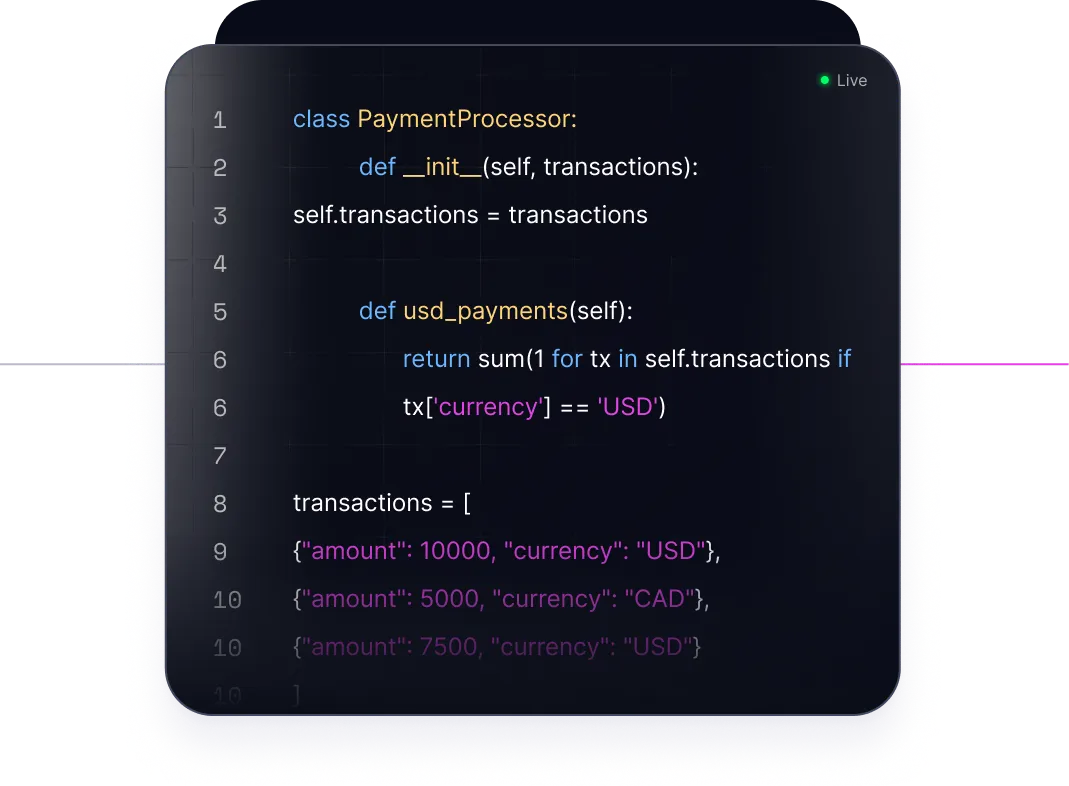
Extensive API documentation
Learn about our API specifications, explore its features, and build your integration with our extensive documentation and production-like sandbox environment.
Read API docs →We're your licensed partner
Operate under our regulated infrastructure so you can launch and scale without needing to acquire complex licences.
Expert implementation support
Work with your dedicated implementation manager as they oversee and manage every aspect of the technical API integration for a smooth experience.
Power global payouts with our API
Access fast, reliable international payments with favourable FX rates and tap into SWIFT, SEPA, SEPA Instant, and UK Faster Payments to reach new markets and deliver local-speed payouts.
Submit up to 10,000 payment requests through a single API, enabling high-volume global payouts with speed, accuracy, and minimal operational overhead.
Let customers pay in USDC while you receive USD directly, with no direct crypto exposure and no added complexity.
Receive payments in the same currencies your customers pay in, avoiding unnecessary FX conversion. Manage funds in your multi-currency wallet and pay suppliers without needing to convert back to your home currency, or exchange with our favourable rates.

Issue customer accounts at scale
Open single or multi-currency customer accounts, whether for users, teams, or business entities, and manage them at volume without manual processes.
Power incoming and outgoing payments through unique IBANs, helping your customers receive funds, make transfers, and reconcile activity with confidence.
Embed fully compliant onboarding into your platform through one API. Outsource KYC, AML, KYB, and fraud screening at scale, reducing operational overhead while ensuring every customer meets regulatory requirements.
Embed accounts directly within your onboarding or customer workflows. Trigger new accounts automatically, link them to wallets or balances, and surface real-time account data in your own system.

Expand your offering with card issuing
Offer payment cards tailored to flexible business needs, including virtual, physical, and tokenised digital-wallet-ready cards, plus both prepaid and debit options.
Set dynamic spending and transaction limits, fund approvals, and flexible permissions to enable controlled business spending and manage costs more effectively.
Create, activate, freeze, unfreeze, and cancel cards via API, with no portal hopping or manual intervention.
Embed card creation in onboarding flows, trigger new cards from approval workflows, or link cards to specific budgets, projects, or customers.


Get in touch with our
implementation team
Our team will help you design the right embedded finance solution for your business, tailored to your product, customers, and growth plans.

How we keep your money safe
The money in the payment accounts held with Equals Money PLC is not covered by the Financial Services Compensation Scheme (FSCS). Instead, your money is protected via a safeguarding method in accordance with the Payment Services Regulations / E-money Regulations. Your money is held in specially designated, safeguarded bank accounts with Tier 1 banks, and is kept separate from our own funds.
Frequently asked questions
- An API (Application Programming Interface) is used to allow different software systems to communicate with each other. It enables applications to request data, trigger actions, or integrate functionality without needing to understand each other's internal code.
- A common example of an API is a payment API, which allows one system to securely send payment instructions to a financial platform. For instance, a business specialising in treasury operations could use an API to automate sending international payments directly from its own software, without logging into a separate dashboard.
- An API suite is a collection of related application programming interfaces designed to work together to deliver a broad set of capabilities. Instead of offering a single, isolated endpoint, an API suite provides a structured toolkit that developers can use to build, automate, and integrate multiple functions within their systems or web applications. A complete API suite typically includes: - Core API endpoints – The functions that allow systems to retrieve, send, create, or update data. - Authentication and security tools – Usually API keys, OAuth, or token-based authentication service to ensure secure access. - Webhooks or event notifications – Allow your systems to receive real-time updates when specific events occur. - Developer documentation – Guides, API specifications, reference materials, code examples, and workflow diagrams to make integration smooth and predictable. - SDKs or client libraries (when provided) – Prebuilt code packages that speed up integration in languages such as Python, JavaScript, or Java. - Versioning and sandbox environments – Support safe testing and ensure stability when updates are released.
- A developer's API suite streamlines development by giving teams a reliable, standardised way to access key functionality without building everything from scratch. This reduces complexity, shortens development cycles, and ensures more consistent behaviour across applications. - Faster integration – Predefined endpoints, documentation, and testing tools reduce onboarding and development time. - Automation of manual processes – APIs can automate workflows such as payments, data transfers, reconciliation, and reporting. - Improved scalability – Applications can grow by consuming only the services they need, making systems more modular and maintainable. - Consistent data handling – Using the same API suite ensures data is exchanged in a uniform, secure, and predictable format. - Reduced risk – Versioning, sandbox environments, and security features help teams test changes safely and maintain compliance. - Better interoperability – An API suite enables different systems—internal tools, finance platforms, ERP systems, or partner applications—to communicate seamlessly and provide flawless delivery. If you or your team are struggling with developing with our API, our expert implementation team will be on hand to oversee and manage all aspects of the technical integration, ensuring the experience is as smooth as possible.